

Tobacco/Diets
“Tobacco allows us to see things as they actually are.”
When he finished the dream of creation, Buinaima [the Creator], left us something to remember him by. He left us tobacco. In this way we can dream like He dreamt. This plant grew alone by the mound where Buinaima sat, dreaming throughout the night. That’s why, when we take tobacco, we concentrate in meditation and think of the gods, and they advise us through our dreams.
Tobacco can be smoked, inhaled, and also chewed when it’s prepared in a paste made from crushed leaves. We use it with respect and caution, because tobacco is a great traveler. Those who have envisioned him in dreams say that he is a very thin man, almost like a skeleton. He walks in space, aided by a cane where his leaves grow, and he wears a necklace of skulls and knees. They are the bones of our ancestors, so old and ghostly like his white smoke. He looks like he’s tired, but he keeps walking, always carrying for us the memory of all that has happened since the earth and her creation formed.
In dreams we reconnect to Buinaima, the Creator, to Jusíguna, the tree-child, and to Buiñaiño, the mother of water from whom was born all that exists when Buinaima blew and illuminated the water with his white saliva. Since then, Buinaima wears a rainbow in his head of hair and dreams in color, and we also dream, because life is the dream of colors from the creator. We live and we dream in all the colors with which Buiñaiño is dressed when she stands up, holding the heavens to save us from storms and make the sun rise and shine again.
Witoto creation myth from Rember Yahuarcaní

Tobacco: A Sacred Plant Across the Americas
Tobacco holds a singular and revered place among the plants of the Americas. It was the most widely cultivated, utilized, and traded crop throughout the continent, found in antiquity from the southernmost reaches of South America to the northern territories of North America, and everywhere in between.
For the Indigenous peoples of the Americas, tobacco was—and in many traditions remains—a sacred plant, often regarded as the most sacred of all. Numerous creation stories and cosmologies place tobacco at the center of existence, portraying it as a primordial gift and a bridge between the human and spiritual worlds.
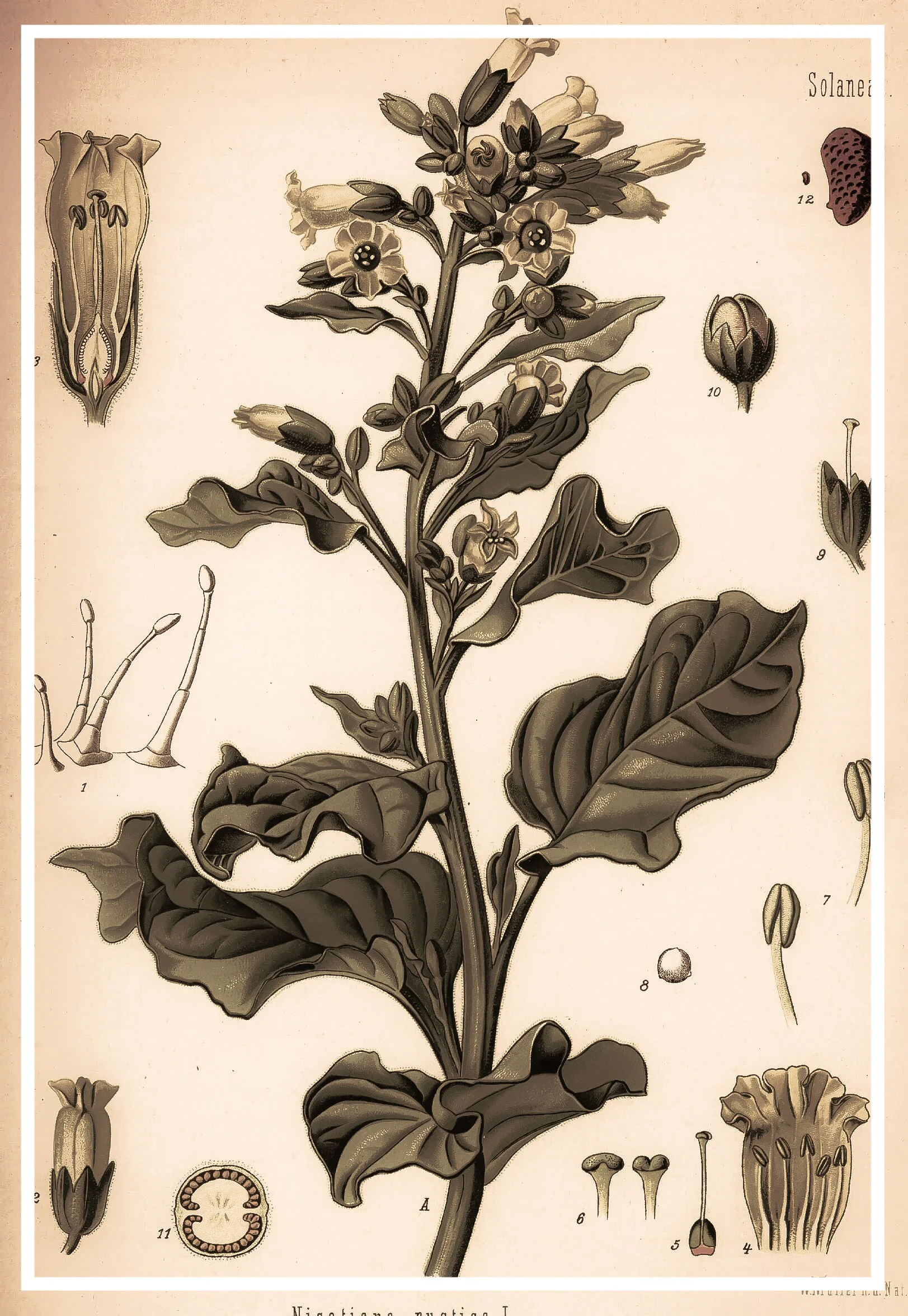
Botanically, tobacco belongs to the nightshade family and exists in many varieties. Today, however, two species are most prominent. Nicotiana tabacum is the variety that dominates the modern tobacco industry and is what most people imagine when they think of tobacco. The other, Nicotiana rustica—often called wild or black tobacco—is an heirloom variety cultivated almost exclusively in the Amazon and is far more potent in nature, containing up to ten times the nicotine of Nicotiana tabacum. This was the original tobacco that spread throughout much of the Americas, including North America. Over time, however—largely due to commercialization—Nicotiana tabacum became more prevalent, as its smoother, less intense qualities made it easier to consume in large quantities.

The Grandfather Plant
Tobacco—often referred to in much of the Amazon as mapacho—is a sacred medicine among Indigenous peoples throughout the Americas, where it is native. It is often referred to as the grandfather plant, the ancient source from which all other plant medicines are said to emerge. Across the Amazon, tobacco holds a nearly universal role in healing traditions, appearing in a wide range of cultures and lineages. It may be administered in several forms—smoked, snuffed, licked, chewed, or drunk—each serving a distinct purpose within both daily and ceremonial contexts.
When smoked, tobacco is primarily used for energetic cleansing, both of individuals and of ceremonial spaces. In North America, this practice is symbolized through the ritual passing of the pipe. Before important decisions were made, participants would inhale the pipe in silence prior to speaking. In this way, it was believed that one would speak from the heart and speak truthfully, guided by clarity rather than impulse.
Tobacco is also understood to invoke and support the action of other plant medicines. Indigenous traditions describe plant spirits as being particularly receptive to the spirit of tobacco. In Ayahuasca ceremonies, for example, the curandero is almost always seen smoking tobacco, and participants may also engage in ritual smoking. Tobacco is believed to clear the energetic field, establish protection, and create a space in which healing can safely occur. From a scientific perspective, this effect may be partly explained by tobacco’s monoamine oxidase inhibiting properties, which can enhance the activity of dimethyltryptamine (DMT) in the Ayahuasca brew. In this sense, tobacco quite literally amplifies the ceremonial experience.
Another traditional method of administration is as a finely ground snuff. For a time, this was in fact the most common way tobacco was consumed among early North American and European settlers. The powdered tobacco may be taken on its own or blended with other plants to produce specific effects. Often applied using a long tube, one person blows the snuff into another’s nostril. Commonly known as rapé (pronounced ha-peh or ra-peh), this preparation produces a strong purging effect in the sinuses, releasing mucus and phlegm, grounding the recipient, clearing the mind, and drawing awareness inward toward one’s center.
Licking or chewing tobacco was also a common way to work with the plant on a regular basis. These methods allowed tobacco to be taken throughout the day and, in some traditions, during ceremony at night. Licking typically involved reducing tobacco into a paste—often combined with other plants—and applying it to the gums or tongue. Chewing involved working with cured tobacco leaves directly. Both methods offer a relatively mild and sustained way to receive tobacco’s benefits while maintaining clarity and presence.
The most potent—and most profound—way tobacco is administered is as a liquid preparation, brewed into a tea-like drink and ingested ceremonially. When tobacco is spoken of as a medicine, a teacher, and a healer, it is this form that carries the greatest power. The drink functions as a powerful purgative, deeply cleansing the intestines, blood, and entire body, and is traditionally used to eliminate parasites, bacteria, and viruses. On the mental and emotional levels, tobacco has a remarkably grounding and clarifying effect. Those who drink it often report an extraordinary sense of presence and lucidity. Unlike other visionary plants such as Ayahuasca, which tend to transport consciousness into other realms, tobacco draws one firmly into the present moment, offering direct insight into life and into oneself. Mental blocks may dissolve, and long-held questions can suddenly become simple and clear.
For many Indigenous peoples, a tobacco ceremony is considered the most powerful means of learning from the plant world. Tobacco is revered as both the great teacher and the great healer. These ceremonies can be intense and physically demanding, as tobacco’s effects are strong and uncompromising. Yet when the process is complete, participants often emerge grounded, clear, strengthened, and deeply connected to the Earth, carrying profound insight into their own nature and the world around them. Because of its potency, tobacco must be administered only by those with deep experience and training, as improper use can be dangerous.

The woman and the man dreamed that God was dreaming about them.
God was singing and clacking his maracas as he dreamed his dream in a cloud of tobacco smoke, feeling happy but shaken by doubt and mystery.
The Makiritare Indians know that if God dreams about eating, he gives fertility and food. If God dreams about life, he is born and gives birth.
In their dream about God’s dream, the woman and the man were inside a great shining egg, singing and dancing and kicking up a fuss because they were crazy to be born. In God’s dream happiness was stronger than doubt and mystery. So dreaming, God created them with a song:
‘I break this egg and the woman is born and the man is born. And together they will live and die. But they will be born again. They will be born and die again and be born again. They will never stop being born, because death is an lie.
Makiritare creation myth
. . . . .
From Sacred Medicine to Modern Stigma
In the modern world, tobacco has become a deeply misunderstood and maligned plant. When people speak of tobacco today, they are most often referring to cigarettes. Cigarettes are typically made from low-quality, reconstituted tobacco grown with heavy use of pesticides, herbicides, and synthetic fertilizers. They generally contain only about 70 percent tobacco, with the remaining 30 percent composed of fillers and chemical additives. In total, a single cigarette may contain over 600 added chemicals. When burned, these substances transform into more than 4,000 compounds—many of them known carcinogens. This does not include the additional chemicals, bleaches, and dyes used in cigarette papers and filters. Notably, early cigarette filters were even made from asbestos.
This chemical mixture—not the tobacco plant itself—is what is inhaled repeatedly, often many times a day over the course of a lifetime. For thousands of years, tobacco has been used medicinally and ceremonially, associated with healing, learning, and the sacred. Pure, natural tobacco has never been linked to disease in traditional cultures; rather, it has been revered as a conduit to the divine. The illnesses associated with modern tobacco use arise from industrial processing and chemical adulteration. When examined honestly—both intellectually and experientially—the true source of harm becomes clear.
As with all powerful medicinal plants, the wisdom of Paracelsus remains true: “Poison is in everything, and no thing is without poison. The dosage makes it either a poison or a remedy.” Tobacco, like all strong medicines, demands respect, knowledge, and intention. When approached with humility and reverence, and used within a ceremonial and informed context, it holds the potential for profound learning, healing, and transformation.
. . . . .

In the beginning there was nothing but nights, and other Indian words call them the two nights—man and woman. They tried to create, to produce a child, but the child was lost before time for its birth. For four times the same happened. Then with a flash of lightning (num yum a wit) came strong twin boys.
The name of the first one was Mo-Cot, and the name of the second was Mo-Cot-tem-ma-ya-wit, meaning creator. These were the first people. They were sitting in the air. There was no earth, no water, no light, nothing but darkness; so they could not see each other, but they could hear each other. They did not call each other “brother,” but “my man.”
Now this Mo-Cot, he asked, “What are we going to do, my man ?“
Mo-Cot-tem-ma-ya-wit answered, “You should know, my man.”
Mo-Cot said, “We must create now.”
Then Mo-Cot created first tobacco. And Mo-Cot-tern-ma-ya-wit invented the pipe and gave it two names: man and woman. This pipe they filled with the tobacco, and not having light of fire or anything of that kind, they drew on the pipe with their mouths, and fire and smoke came into it.
Cahuilla creation myth

Tobacco and Tree Dietas
A dieta—from the Spanish term—is a sacred process of learning directly from a plant. Unlike acquiring knowledge through books or intellectual study, a dieta is an embodied, experiential practice. In this way, it is said that the plants themselves become our teachers. Through them, we learn and heal, using the plant as a living medium that opens us to a space of light and awareness. Each plant carries its own healing qualities and teachings, offering insight into particular aspects of our physical, emotional, and spiritual lives. Every plant has the capacity to heal specific conditions and to reveal its own unique expression of light. Ultimately, however, all plants point toward the same fundamental truth: that which we already are. They teach us about nature and natural law, about ourselves and our place in the world, and they open us to realities beyond the visible. Above all, they guide us toward harmony, inner peace, and a way of living aligned with Truth and with Knowledge—not intellectual knowledge, but knowledge born of direct experience.
A dieta typically involves a period of intentional isolation, lasting anywhere from a few days to several months. In our tradition, the process generally unfolds in cycles of seven-day dietas, though the length may be adjusted according to the needs and condition of the participant. During this time, the dieter remains largely in solitude, staying in their room and limiting contact with others. Food is kept extremely light—usually juices or simple soups—and is consumed only at breakfast and lunch. Each evening, the plant medicine is ingested under the guidance of the curandero, who accompanies the participant closely during the initial phase, when the experience may be particularly intense. After drinking the plant—and often after purging—the work continues in the dream world. These medicines tend to awaken the realm of dreams, which frequently reveals insight into the cleansing and healing that is taking place. While the curandero remains available for guidance and questions, much of the dieta unfolds in solitude, in deep encounter with one’s thoughts, mind, and inner being. In this space, repetitive patterns, limiting beliefs, fears, and inner obstacles are brought into awareness and, over time, released.
The specific plant chosen for a dieta is determined through a diagnostic performed by the curandero. Plants are prescribed according to what is perceived to be most beneficial for the individual. Many of these plants are trees, traditionally regarded as bridges between the earth and the heavens. Ancient, strong, and wise, trees possess a profound capacity to teach and heal. On a physical level, they are deeply cleansing, purifying the blood, stomach, and intestines—areas where illness and stagnation often accumulate. On the level of the mind, they help dissolve entrenched thought patterns and belief systems that limit our growth. Energetically, they clear blockages and restore the free flow of life force throughout the body. This understanding parallels the concept of meridians in Traditional Chinese Medicine or the energetic channels described in Ayurveda.
In most cases, these plants are administered together with tobacco. Tobacco is regarded as the carrier plant—the medicine that enables and regulates the action of other plants. Known as the grandfather plant, it is seen as an ancient intelligence that supports the existence and work of all other plant medicines. Tobacco itself is a powerful teacher and healer, and it is often the first plant with which one diets. It is considered one of the most potent cleansers of the body on all levels: physical, mental, and energetic.
The initial phase of working with these plants focuses on cleansing. As the body, mind, and energetic field are purified, deeper healing and teaching can begin to unfold. This cleansing process can be demanding, as it often involves significant purging. When tobacco is taken in liquid form, its primary action is as a powerful emetic and energetic purifier. Purging may manifest as vomiting, diarrhea, crying, shaking, or alternating sensations of heat and cold. While Western culture often associates purging with something negative, traditional medical systems—such as those of the Amazon and Ayurveda—understand regular purging to be essential for detoxification on physical, emotional, energetic, and spiritual levels. Through this process, impurities, toxins, stagnant energies, and even negative emotions and thoughts are released. As purging progresses, participants frequently report a sense of lightness, clarity, and a deepening inner peace.
The dieta often begins with trees, which are considered among the Master Plants. Symbolically, trees unite heaven and earth. Their roots penetrate the soil, connecting us to Mother Earth and to the underworld—known in Andean cosmology as the Ukhu Pacha, the realm of emotions and the unseen. The trunk represents our physical body and the everyday world, the Kay Pacha. The branches extend skyward into the heavens, symbolizing the spiritual body and the Hanaq Pacha. Through fasting, isolation, and communion with these trees, healing can occur simultaneously on all three levels: physical, mental-emotional, and spiritual. Each tree possesses its own personality and medicine. Each addresses specific physical conditions, works with particular aspects of the mind and emotions, and carries unique teachings within the spiritual or shamanic realms. Upon completing a dieta, a lasting connection is formed with the tree. It may be said that the tree becomes an ally, establishing a spiritual bond or contract. Over time, this ally continues to teach—much like a seed that, with care and attention, grows into a strong tree offering its fruits, flowers, shade, protection, wisdom, and medicine.
As with all powerful plant medicines, a sincere intention and willingness to engage are essential. The path is rarely easy, and often deeply challenging. Yet for those who approach it with courage, humility, and commitment, the rewards can be profound and life-transforming.
The Role of the Curandero
The word curandero is Spanish and may be translated as “one who cures,” “healer,” or “doctor.” Within the curanderismo tradition, however, the role encompasses far more than physical medicine alone. There are several distinct paths and expressions of curanderos. Vegetalistas are healers who work primarily with plants, much like herbalists. Curanderos, in a more specific sense, are those who can access non-ordinary states of consciousness and guide healing within those realms. In certain traditions, such as that of the Shipibo, there are also the moraya—mythic figures said to have attained an extraordinary level of mastery over the world and its unseen dimensions.
Within this lineage, many curanderos develop specialized areas of practice. Some are ayahuasqueros, who work primarily with the master plant ayahuasca. Others are sanangueros, specializing in the master plant chiric sanango. There are tabaqueros, whose primary medicine and teacher is tobacco. Some curanderos further focus their work on specific domains, such as women’s health, bone setting, energetic protection, attraction, or other specialized forms of healing.
One way to understand the curandero is to think of them as a physician of both visible and invisible realms. People seek out a curandero when they are suffering and in need of help. This suffering may be physical, or it may manifest as conditions increasingly common in modern times—depression, anxiety, chronic pain, loss of joy, lack of purpose, trauma, or emotional distress. While certain plants may be used to address physical symptoms, the curandero’s work often involves uncovering and treating the deeper root of the illness. These roots frequently lie within the psyche, the emotional body, or the energetic field, and must be brought into awareness and released.
It is here that the knowledge of master plants—such as tobacco, ayahuasca, and countless trees and medicinal plants—becomes essential. The curandero prescribes specific plants chosen to engage the underlying cause of the ailment. This work may take place in ceremonial contexts, such as an ayahuasca ceremony, or through the offering of a dieta, in which the patient enters a period of isolation, restricts their diet, and ingests a particular plant nightly in order to heal and learn directly from it. Some dietas are administered to address specific conditions, while others are undertaken to deepen learning, to “dominate” a plant, or to establish it as an ally that offers guidance and support throughout one’s life.
The path of becoming a curandero is long, demanding, and profoundly transformative. A disciple undergoes an intensive apprenticeship centered on sustained work with plants, often through extended periods of dieta and isolation. The disciple studies under a curandero who becomes their maestro, or teacher, guiding them through the challenges of learning and initiation. This process is frequently arduous. Long periods of isolation test the mind and force the disciple to confront its nature directly. Severe dietary restriction weakens the body, and within these traditions it is often said that when the body is weakened, the spirit becomes more accessible, allowing the medicine to penetrate deeply.
Yet this vulnerability can also bring great difficulty. Regular ingestion of powerful plants can surface suffering, doubt, fear, trauma, separation, and deeply held belief systems. Through this sustained engagement, the disciple gradually comes to see into their own nature. They learn about the human condition, about reality and natural law, and about the ways in which plants can open, teach, and heal. Through this slow and often painful process, self-knowledge begins to emerge.
After years of training, the disciple may gradually begin to work. This often starts by assisting their teacher, observing and supporting ceremonies, and eventually administering plants themselves. Over time, and when the maestro feels the student is ready, the apprentice is sent out to work independently as a curandero. No two paths are identical; each curandero’s process is unique. What distinguishes a skilled and ethical curandero is rigorous training, deep self-inquiry, and extensive experiential knowledge gained through sustained work with plants.
Through their own initiation, the curandero acquires not only skill but humility. They come to trust the healing intelligence of the plants, recognizing them as gateways to a greater force—whether understood as the Universe, Creation, or God. The curandero knows that it is not they who heal. Rather, they create and hold a space—through discipline, integrity, and devotion—within which patients may encounter this higher healing power themselves. The curandero learns how to guide the medicine, how to modulate its intensity, how to administer appropriate dosages, and how to accompany others through experiences that may be both profoundly challenging and deeply beautiful.
This role is not to be taken lightly. If such a space is not held with skill and care, it can expose patients to harm. In this sense, the curandero is much like an open-heart surgeon: when one’s heart is laid bare, it is essential that the person guiding the process has undergone thorough training. The curandero has journeyed deeply within themselves so that they may safely and skillfully guide others as they do the same.
Apprenticeship Program
The Apprenticeship Program is a traditional training and initiatory path undertaken to learn deeply about oneself and to develop a living relationship with plants. It is a process of self-mastery, initiation, and disciplined training for those who feel called to walk the path of the curandero.
Initiation
Initiations were once central practices in cultures throughout the world. While modern society has gained and learned much, one essential element of the human journey has largely faded: the rite of initiation. In many traditional cultures, initiation marked the transition from adolescence into adulthood. It served as both a test and a rite of passage—a shedding of the old identity of the child and a rebirth into one’s new role as an adult.
Beyond this universal passage, initiation was also reserved for select individuals who either chose, or were chosen, to enter specialized roles within the community, such as members of the priestly caste, healers, or leaders. To step into these roles, initiates underwent strict and demanding processes that challenged them on every level: physical, mental, emotional, and spiritual. These initiations varied in length but often unfolded over months or even years.
At their core, many initiation rites embody the archetypal process of death and rebirth. Old beliefs, traumas, habitual patterns, identities, and ways of perceiving the world are confronted, released, or transformed, allowing a new way of being to emerge. This transformation may occur through a single profound, death-like experience or through a series of successive “deaths.” It is often said that the journey of the curandero is a journey of many deaths. Like the layers of an onion, each layer must be stripped away, revealing what lies ever closer to one’s true essence.
The Process
In this initiatory process, we embark on the greatest journey of all: the journey of the Self. As inscribed at the Temple of Apollo at Delphi, the foundation of all wisdom is Know Thyself. Through deep self-reflection and sustained inquiry, this journey begins.
The apprenticeship program we offer is rooted in the initiatory process we ourselves underwent within the Mamancunawa lineage. It weaves together this traditional framework with the knowledge and experience we have gained beyond the lineage as well. This path is what allows an initiate to earn the title of Tabaquero—a curandero specializing in tobacco and trees. The initiatory process is long and demanding, requiring extended periods of isolation, fasting from food and external stimuli, and the ceremonial ingestion of powerful plant preparations.
Isolation has long been recognized across cultures as a potent initiatory rite in its own right. By withdrawing from the external world and minimizing all forms of stimulation, one is brought into direct and sustained relationship with oneself and with the mind. This can give rise to many challenges: boredom, anxiety, fear, depression, a sense of losing control, and other deeply rooted patterns. Yet it is precisely through these challenges that we begin to truly observe the mind—its tendencies, its narratives, and its mechanics. With nothing to distract us and no one to engage, we are compelled to turn inward. A process of genuine self-inquiry begins, through which we learn not only what the mind contains, but how it functions.
As the mind gradually settles, sensitivity deepens. Perception shifts. We begin to hear, see, and smell differently, becoming aware of subtle dimensions of life that were always present but obscured by constant stimulation and outward focus. In this stillness, the senses refine, and awareness naturally expands.
Fasting constitutes the second core element of this initiatory rite. Used by spiritual and healing traditions throughout the world, fasting is a powerful means of physical and energetic renewal. As food intake is reduced, the body is able to redirect energy away from digestion and toward repair and healing. Initially, fasting can be difficult, as the body responds with cravings and discomfort. Over time, the body may become weak due to the absence of food. Yet it is often in this very state of weakness that sensitivity and awareness are greatly heightened. As many traditions observe, when the body is weak, the spirit can become strong.
This dynamic is familiar to many through experiences of illness, such as the flu, when appetite naturally diminishes and the body enters a self-healing state. In such moments, despite physical weakness, the mind often becomes clearer and more reflective. Thoughts may flow with greater ease, and there can be an increased sense of presence and attunement to the moment.
During the dieta, minimal to no food is consumed, and only the plant being dieted is ingested. In this way, a deep and intimate relationship is formed with the plant, as it becomes one’s sole source of nourishment and focus, aside from oneself. For the duration of the dieta, the initiate is in constant communion with the plant. Often, the plant preparation is combined with tobacco, which serves as a regulator and teacher and is traditionally considered “food” for the spirits. Through this union of fasting, isolation, and plant medicine, the conditions are created for profound learning, transformation, and initiation to unfold.
Cleansing, Fortification, and Integration
When these strong plants are ingested, the first intention is to cleanse and clear the system. This process often involves significant purging. The trees and tobacco used in this work possess powerful cleansing properties that act on the blood, the gastrointestinal tract, and various organs where illness and imbalance are traditionally believed to be stored. As the physical body is очищed, a corresponding opening occurs on the energetic level. Energy begins to move and flow as it was originally designed to do, much like the natural state we experienced in childhood.
For those familiar with Traditional Chinese Medicine, this can be understood as the opening of the meridians and the free flow of Qi. As cleansing occurs and harmony and movement are restored, it becomes essential that the body, mind, and spirit are then fortified. Many of the trees dieted in this process provide strength and protection, ensuring that as we enter this renewed state, we are grounded, clear, resilient, and supported. The aim is not to become invincible or rigid, but to emerge renewed—equipped with new awareness and tools to meet life with greater clarity and skill.
Throughout the apprenticeship, the plants themselves serve as primary teachers, offering insight into our own nature, the nature of the world, and the living intelligence of the plant realm. Alongside this, the initiate is guided by maestros—human teachers who have walked this path before. The curandero or maestro accompanies the initiate at every stage of the journey, holding space and providing guidance, while recognizing that the journey itself must be undertaken by the initiate alone. The maestro’s role includes preparing the remedies, helping the initiate understand and interpret what arises internally, and transmitting the practical and energetic tools necessary for the work.
Among the skills taught in this process are how to work with tobacco and trees; how to prepare and administer remedies; how to soplar with tobacco for energetic cleansing; how to make perfumes; how to sing ícaros; how to give and guide dietas; how to work with a chacapa (a bundle of leaves used for cleansing); how to make and work with a pipe; how to prepare and apply plant baths; how to cleanse spaces; how to prepare body and organ cleanses; and how to create remedies for a variety of common ailments.
Beyond formal instruction, the maestro also teaches through presence and lived experience. Ways of being, energetic fields, and embodied knowledge are transmitted directly through relationship and proximity. There is a subtle yet powerful transfer of understanding, tools, vibration, and vision, as well as a synchronization of energies between teacher and student. Throughout the process, the maestro remains present both physically and energetically, and between dietas is available for questions, reflection, and integrative work as the teachings continue to unfold.
Length and Structure of the Program
In the tradition in which we work, the path typically begins with a tobacco dieta. Tobacco is regarded as one of the great master plants—one of the few with the capacity to teach directly about the Self and to initiate a person into the path of the doctor, or curandero. As a first dieta, tobacco is especially well suited because it works simultaneously on all levels of being. It cleanses and clears, opens perception, and then begins to fortify and protect. When the dieta is complete, it often leaves the initiate feeling clean, open, strong, clear, grounded, insightful, and energetically protected.
From there, the initiate begins to diet trees. Certain trees are considered powerful allies—teachers that support and guide one along the path of curanderismo. Trees are also understood symbolically as bridges between heaven and earth: rooted deeply in the soil while reaching upward toward the sky. Each tree is carefully selected by the maestro and assigned to the student based on what is most beneficial for their development at that stage of the process. In total, twelve different trees are dieted. Once these twelve tree dietas are completed, the initiate has received sufficient preparation to enter the final phase of initiation.
In this final phase, the initiate returns once more to tobacco. This concluding dieta is known as the maestría, or the master teacher diet. It is during this dieta that the teachings and energies of all previously dieted trees are aligned and integrated. The initiate drinks a significant quantity of tobacco, allowing them to fully embody the role they are stepping into. While this phase may sound daunting, the progression through the earlier dietas prepares the initiate thoroughly for this final initiation.
Each dieta typically lasts seven days. For some, this may feel long; for others, surprisingly brief. Certain dietas can be extended to two weeks for those who wish to deepen their work with a particular plant. These dietas are generally shorter than some other traditional plant dietas because the process itself is more concentrated and physically intense. The duration of any dieta depends on the maestro and the intensity of the work involved. Longer dietas are often less physically demanding but can be psychologically challenging due to extended isolation, greater food intake, and more widely spaced plant ingestion.
In contrast, during these seven-day dietas, food is typically abstained from entirely, with only juice provided twice daily, or with one meal being juice and one solid meal of vegetable soup. The plant medicine is taken each day, often producing strong physical and mental purging alongside a profound inner process. Though demanding, this intensity allows for deep cleansing, accelerated learning, and powerful transformation within a relatively contained period of time.
Who This Program Is For
The Apprenticeship Program is, at its heart, for anyone seeking a deeper understanding of themselves. One does not need to aspire to work with plants in a ceremonial or professional capacity to benefit from this path. Many participants enter the program with no intention of becoming plant practitioners at all. People from all walks of life are drawn to the dieta as a means of healing, self-discovery, and strengthening their connection to themselves, to others, and to the world around them.
Some may begin with a single dieta and find the experience so transformative that they feel called to continue through the entire process. Along the way, many participants discover new ways of perceiving reality and relating to life. The insights gained often naturally find their way into one’s existing work and vocation—whether as psychologists, counselors, teachers, massage therapists, energy workers, healers, coaches, or in countless other fields. The program does not seek to redirect one’s path, but rather to deepen whatever path already calls to them.
For those who do feel drawn to working directly with plants—and who may one day wish to hold ceremonial space—the Apprenticeship Program is especially well suited. Through this lineage, participants learn to work with tobacco and tree medicines in a grounded and disciplined way. The process is powerful, and the depth to which one chooses to go is limited only by one’s own commitment and sincerity. The program also provides a strong foundation for those who already work with, or wish to eventually work with, other plant medicines such as ayahuasca, San Pedro (huachuma), coca, and others.
In all cases, the Apprenticeship Program meets each individual where they are, offering a framework for profound personal growth, healing, and learning—guided by the wisdom of the plants and one’s own lived experience.
Time and Cost
Each dieta lasts eight days, consisting of seven days of ceremonial work followed by one day of rest and integration. The complete Apprenticeship Program includes fourteen dietas in total: one tobacco dieta, twelve tree dietas, and a final master tobacco dieta (Maestría). Some dietas may be extended to two weeks for those who wish to engage more deeply with a particular plant.
The minimum time required to complete the program is approximately twenty weeks, typically spread over a period of one to three years, allowing adequate time for integration between dietas.
The cost of the Apprenticeship Program is the same as the cost of completing individual dietas. There is no additional fee for the apprenticeship training or for the transmission of tools and teachings. Once a participant formally begins the program, the instructional aspect—covering the full range of techniques and practices—is integrated naturally into the dietas themselves.
After completing six tree dietas (halfway through the apprenticeship), participants receive a 10% discount on all subsequent dietas. While the program represents a meaningful investment of time, energy, commitment, and financial resources, this reflects the traditional path of the Western medical practitioner and the depth of training involved.
To be considered for the Apprenticeship Program, all dietas must be completed with us, with rare exceptions considered on an individual basis. Upon completion of the maestría, students are offered the opportunity to apprentice and shadow us directly. This includes sitting with us in multiple tobacco ceremonies and shadowing our work across two different retreats (dietas). These experiences provide direct, experiential learning and a clear understanding of how the work is carried out in practice.
At the conclusion of the training, each participant is evaluated individually based on their skill, integrity, and depth of connection. Those who meet our criteria are offered a certification diploma, along with comprehensive tools, techniques, remedies, and practical guidelines for continued practice. We also offer our Apprentices access to our online portal where we have dozens of recorded classes, lectures, interviews, remedies and more. We constantly update this with new material that Jason and Merav contribute. Also Apprentices are given access to a private WhatsApp group with other Apprentices that allow them to have open dialogue and communication creating a community of healing practitioners. Finally, Jason and Merav will hold regular Peer Support Group calls for working practitioners to reflect cases, receive advice, protocols, etc.
All of the aforementioned services are included within the costs of the dietas and Apprenticeship Program, minus 2 things:
the online portal incurs a one-time fee of $99 that is good for life. This helps us cover the rather large hosting fees for keeping so many videos and classes online. And its an investment that goes beyond the dietas and is a resource for continued learning.
Participation in group calls for the Peer Support Group incur a per-call fee TBD
The Journey
The Apprenticeship Program is a demanding and transformative journey. In many shamanic traditions, it is said that the path of the shaman is a path of suffering—not as punishment, but as a process of profound transformation. Through initiation, the student enters a prolonged cycle of isolation, deprivation, cleansing, purging, deep self-inquiry, and eventual rebuilding. This process is not easy, nor is it meant to be. It challenges the initiate on every level of being.
It is the archetypal Hero’s Journey—the greatest journey one can undertake: the journey inward. Through the gradual dying away of what is old, limited, or no longer true, space is created for something new to emerge. In this rebirth, we begin to glimpse our own potential and to recognize the beauty, intelligence, and quiet magic woven into life itself. We come to understand that life is not happening to us, but for us.
As the old narratives fall away, we are no longer bound by our stories. We step into our capacity to shape our own lives, becoming conscious creators rather than unconscious participants. Our dream space opens, our sensitivity to the world deepens, and our relationship to existence becomes more intimate and alive. Through this inward descent, we shed the former self and begin to walk a path of wisdom, clarity, and embodied power.
For those who feel the call and possess the willingness to walk this path, the Apprenticeship Program can become one of the most meaningful and rewarding decisions of a lifetime.
Calendar
Tobacco and Tree Dieta Retreat Schedule
For additional articles on tobacco, visit my Blog page

Tobacco maestro Don Ernesto
Please note: We DO NOT sell or distribute tobacco or tobacco related products including e-cigarettes, cigars, and e-liquid, herbal cigarettes, or production equipment specifically marketed for the production of tobacco products